

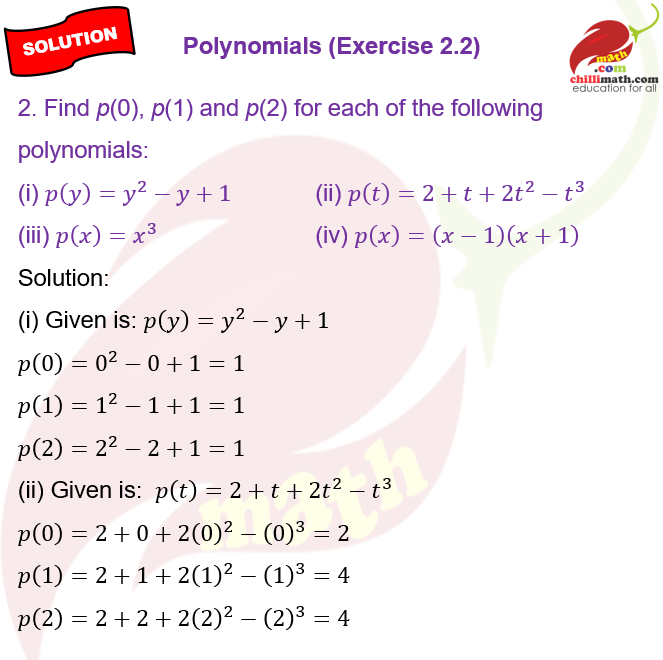
2. Find p(0), p(1) and p(2) for each of the following polynomials:
(i) (p(y)=y^2-y+1)
(ii) (p(t)=2+t+2t^2-t^3)
(iii) (p(x)=x^3)
(iv) (p(x)=(x-1)(x+1))
Polynomials
Exercise 2.2

Class 9
Polynomials
Exercise 2.2
1. Find the value of the polynomial (5x-4x^2+3) at
2. Find p(0), p(1) and p(2) for each of the following polynomials:
3. Verify whether the following are zeroes of the polynomial, indicated against them.
(i) (p(x)=3x+1), (x=-{1over 3})
(ii) (p(x)=5x-pi), (x={4over 5})
(iv) (p(x)=(x+1)(x-2)), (x=-1, 2)
(vi) (p(x)=lx+m), (x=-{mover l})
(vii) (p(x)=3x^2-1), (x=-{1over{sqrt 3}},{2over {sqrt 3}})
(viii) (p(x)=2x+1), (x={1over 2})
4. Find the zero of the polynomial in each of the following cases:
(vii) p(x) = cx + d, c ≠ 0, c, d are real numbers.

