A trust fund has Rs 30,000 that must be invested in two different types of bonds. The first bond pays 5% interest per year

19. A trust fund has Rs 30,000 that must be invested in two different types of bonds. The first bond pays 5% interest per year, and the second bond pays 7% interest per year. Using matrix multiplication, determine how to divide Rs 30,000 among the two types of bonds. If the trust fund must obtain an annual total interest of:
(a) Rs 1800
(b) Rs 2000


A trust fund has Rs 30,000 that must be invested in two different types of bonds. The first bond pays 5% interest per year

Previous


Next

Matrices

Exercise 3.2

1. Let (A=begin{bmatrix}2 & 4 \ 3 & 2 end{bmatrix}), (B=begin{bmatrix}1 & 3 \ -2 & 5 end{bmatrix}), (A=begin{bmatrix}-2 & 5 \ 3 & 4 end{bmatrix}) Find each of the following:

(i) A + B
(ii) A – B
(iii) 3A – C
(iv) AB
(v) BA

2. Compute the following:

(i) (begin{bmatrix}a & b \ -b & a end{bmatrix})+(begin{bmatrix}a & b \ b & a end{bmatrix})

(ii) (begin{bmatrix}a^2+b^2 & b^2+c^2 \ a^2+c^2 & a^2+c^2 end{bmatrix})+(begin{bmatrix}2ab & 2bc \ -2ac & -2ab end{bmatrix})

(iii) (begin{bmatrix}-1 & 4 & -6 \ 8 & 5 & 16\2 & 8 & 5 end{bmatrix})+(begin{bmatrix}12 & 7 & 6 \ 8 & 0 & 5\3 & 2 & 4 end{bmatrix})

(iv) (begin{bmatrix}cos^2x & sin^2x \ sin^2x & cos^2xend{bmatrix})+(begin{bmatrix}sin^2x & cos^2x \ cos^2x & sin^2x end{bmatrix})

3. Compute the indicated products:

(i) (begin{bmatrix}a & b \ -b & a end{bmatrix})(begin{bmatrix}a & -b \ b & a end{bmatrix})

(ii) (begin{bmatrix}1 \ 2 \ 3 end{bmatrix})(begin{bmatrix}2 & 3 & 4 end{bmatrix}) 

(iii) (begin{bmatrix}1 & -2 \ 2 & 3 end{bmatrix})(begin{bmatrix}1 & 2 & 3 \ 2 & 3 & 1 end{bmatrix})

(iv) (begin{bmatrix}2 & 3 & 4 \ 3 & 4 & 5 \ 4 & 5 & 6 end{bmatrix})(begin{bmatrix}1 & -3 & 5 \ 0 & 2 & 4\ 3 & 0 & 5end{bmatrix})

(v) (begin{bmatrix}2 & 1 \ 3 & 2 \ -1 & 1 end{bmatrix})(begin{bmatrix}1 & 0 & 1 \ -1 & 2 & 1 end{bmatrix})

(vi) (begin{bmatrix}3 & -1 & 3 \ -1 & 0 & 2 end{bmatrix})(begin{bmatrix}2 & -3 \ 1 & 0 \ 3 & 1 end{bmatrix})

4. If  (A=begin{bmatrix}1 & 2 & -3\ 5 & 0 & 2 \ 1 & -1 & 1 end{bmatrix}),(B=begin{bmatrix}3 & -1 & 2\ 4 & 2 & 5 \ 2 & 0 & 3 end{bmatrix}) and (C=begin{bmatrix}4 & 1 & 2\ 0 & 3 & 2 \ 1 & -2 & 3 end{bmatrix}), then compute (A+B) and (B – C). Also, verify that A + (B – C) = (A + B) – C.

5. If  (A=begin{bmatrix}{2over 3} & 1 & {5over 3}\ {1over 3} & {2over 3} & {4over 3} \ {7over 3} & 2 & {2over 3} end{bmatrix}) and (B=begin{bmatrix}{2over 5} & {3over 5} & 1\ {1over 5} & {2over 5} & {4over 5} \ {7over 5} & {6over 5} & {2over 5} end{bmatrix}), then compute 3A – 5B.

6. Simplify  (cosθbegin{bmatrix}cosθ & sinθ \ -sinθ & cosθ end{bmatrix})+(sinθbegin{bmatrix}sinθ & -cosθ \ cosθ & sinθ end{bmatrix}).

7. Find X and Y, if

(i) (X+Y=begin{bmatrix}7 & 0 \ 2 & 5 end{bmatrix}) and (X-Y=begin{bmatrix}3 & 0 \ 0 & 3 end{bmatrix})

(ii) (2X+3Y=begin{bmatrix}2 & 3 \ 4 & 0 end{bmatrix}) and (3X+2Y=begin{bmatrix}2 & -2 \ -1 & 5 end{bmatrix}) 

8. Find X, if  (Y=begin{bmatrix}3 & 2 \ 1 & 4 end{bmatrix}) and (2X+Y=begin{bmatrix}1 & 0 \ -3 & 2 end{bmatrix})

9. Find x and y, if  2(begin{bmatrix}1 & 3 \ 0 & x end{bmatrix}) + (begin{bmatrix}y & 0 \ 1 & 2 end{bmatrix})=(begin{bmatrix}5 & 6 \ 1 & 8 end{bmatrix})

10. Solve the equation for x, y, z and t, if 

2(begin{bmatrix}x & z \ y & t end{bmatrix})+3(begin{bmatrix}1 & -1 \ 0 & 2 end{bmatrix})=3(begin{bmatrix}3 & 5 \ 4 & 6 end{bmatrix})

11. If (xbegin{bmatrix}2 \ 3 end{bmatrix})+(ybegin{bmatrix}-1 \ 1 end{bmatrix})=(begin{bmatrix}10 \ 5 end{bmatrix}), find the values of x and y.

12. Given 3(begin{bmatrix}x & y \ z & w end{bmatrix})=(begin{bmatrix}x & 6 \ -1 & w end{bmatrix})+(begin{bmatrix}4 & x+y \ z+w & 3 end{bmatrix}), find the values of x, y, z and w.

13. If  (F(x)=begin{bmatrix}cosx & -sinx & 0 \ sinx & cosx & 0 \ 0 & 0 & 1 end{bmatrix}), show that (F(x)F(y)=F(x+y)).

14. Show that 

(i) (begin{bmatrix}5 & -1 \ 6 & 7 end{bmatrix})(begin{bmatrix}2 & 1 \ 3 & 4 end{bmatrix})≠(begin{bmatrix}2 & 1 \ 3 & 4 end{bmatrix})(begin{bmatrix}5 & -1 \ 6 & 7 end{bmatrix})

(ii) (begin{bmatrix}1 & 2 & 3 \ 0 & 1 & 0  \ 1 & 1 & 0end{bmatrix})(begin{bmatrix}-1 & 1 & 0 \ 0 & -1 & 1  \ 2 & 3 & 4end{bmatrix})≠(begin{bmatrix}-1 & 1 & 0 \ 0 & -1 & 1  \ 2 & 3 & 4end{bmatrix})(begin{bmatrix}1 & 2 & 3 \ 0 & 1 & 0  \ 1 & 1 & 0end{bmatrix})

15. Find (A^2-5A+6I), if (A=begin{bmatrix}2 & 0 & 1 \ 2 & 1 & 3  \ 1 & -1 & 0end{bmatrix})

16. If (A=begin{bmatrix}1 & 0 & 2 \ 0 & 2 & 1  \ 2 & 0 & 3end{bmatrix}), prove that (A^3-6A^2+7A+2I=0)

17. If  (A=begin{bmatrix}3 & -2 \ 4 & -2end{bmatrix}) and (I=begin{bmatrix}1 & 0 \ 0 & 1end{bmatrix}), find k so that (A^2=kA-2I).

18. If  (A=begin{bmatrix}0 & -tan{αover 2} \ tan{αover 2} & 0end{bmatrix})  and I is the identity matrix of order 2, show that I+A=(I-A)(begin{bmatrix}cosα & -sinα \ sinα & cosαend{bmatrix}).

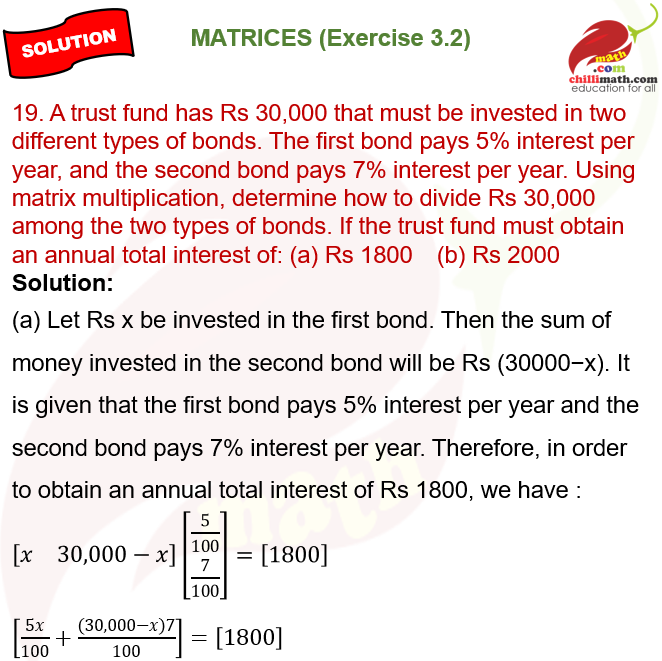
19. A trust fund has Rs 30,000 that must be invested in two different types of bonds. The first bond pays 5% interest per year, and the second bond pays 7% interest per year. Using matrix multiplication, determine how to divide Rs 30,000 among the two types of bonds. If the trust fund must obtain an annual total interest of:
(a) Rs 1800
(b) Rs 2000

20. The bookshop of a particular school has 10 dozen chemistry books, 8 dozen 
physics books, 10 dozen economics books. Their selling prices are Rs 80, Rs 60
and Rs 40 each respectively. Find the total amount the bookshop will receive from selling all the books using matrix algebra.
Assume X, Y, Z, W and P are matrices of order 2 × n, 3 × k, 2 × p, n × 3 and p × k,
respectively. Choose the correct answer in Exercises 21 and 22.
21. The restriction on n, k and p so that PY + WY will be defined are:
(A) k = 3, p = n
(B) k is arbitrary, p = 2
(C) p is arbitrary, k = 3
(D) k = 2, p = 3
22. If n = p, then the order of the matrix 7X – 5Z is:
(A) p × 2
(B) 2 × n
(C) n × 3
(D) p × n


Leave A Comment

Logged in as chillimath. Log out »


error: Content is protected !!