
1.2.3 Associativity
(i) Whole numbers
Recall the associativity of the four operations for whole numbers through this table:
| Operation | Numbers | Remarks |
|---|---|---|
| Addition | ……… | Addition is associative |
| Subtraction | ……… | Subtraction is not associative |
| Multiplication | \begin{aligned} & \text { Is } 7 \times(2 \times 5)=(7 \times 2) \times 5 \text { ? } \\ & \text { Is } 4 \times(6 \times 0)=(4 \times 6) \times 0 \text { ? } \\ & \text { For any three whole } \\ & \text { numbers } a \text {, } b \text { and } c \\ & a \times(b \times c)=(a \times b) \times c \end{aligned} | Multiplication is associative |
| Division | ……… | Division is not associative |

Fill in this table and verify the remarks given in the last column.
Check for yourself the associativity of different operations for natural numbers.
(ii) Integers
Associativity of the four operations for integers can be seen from this table
| Operation | Numbers | Remarks |
|---|---|---|
| Addition | \begin{aligned} & \text { Is }(-2)+[3+(-4)] \\ & =[(-2)+3)]+(-4) ? \\ & \text { Is }(-6)+[(-4)+(-5)] \\ & =[(-6)+(-4)]+(-5) ? \\ & \text { For any three integers } a, b \text { and } c \\ & a+(b+c)=(a+b)+c \end{aligned} | Addition is associative |
| Subtraction | Is 5-(7-3)=(5-7)-3 ? | Subtraction is not associative |
| Multiplication | \begin{aligned} & \text { Is } 5 \times[(-7) \times(-8) \\ & =[5 \times(-7)] \times(-8) ? \\ & \text { Is }(-4) \times[(-8) \times(-5)] \\ & =[(-4) \times(-8)] \times(-5) ? \\ & \text { For any three integers } a, b \text { and } c \\ & a \times(b \times c)=(a \times b) \times c \\ & \hline \end{aligned} | Multiplication is associative |
| Division | \begin{aligned} & \text { Is }[(-10) \div 2] \div(-5) \\ & =(-10) \div[2 \div(-5)] ? \end{aligned} | Division is not associative |

10. Write.
(i) The rational number that does not have a reciprocal.
(ii) The rational numbers that are equal to their reciprocals.
(iii) The rational number that is equal to its negative.
11. Fill in the blanks.
(i) Zero has \_\_\_\_ reciprocal.
(ii) The numbers \_\_\_\_ and \_\_\_\_ are their own reciprocals
(iii) The reciprocal of -5 is \_\_\_\_ .
(iv) Reciprocal of \frac{1}{x}, where x \neq 0 is \_\_\_\_ .
(v) The product of two rational numbers is always a \_\_\_\_ .
(vi) The reciprocal of a positive rational number is \_\_\_\_ .
1.3 Representation of Rational Numbers on the Number Line
You have learnt to represent natural numbers, whole numbers, integers and rational numbers on a number line. Let us revise them.
Natural numbers
(i)
Whole numbers
(ii)
Integers
(iii)
(iv)
(v)
nu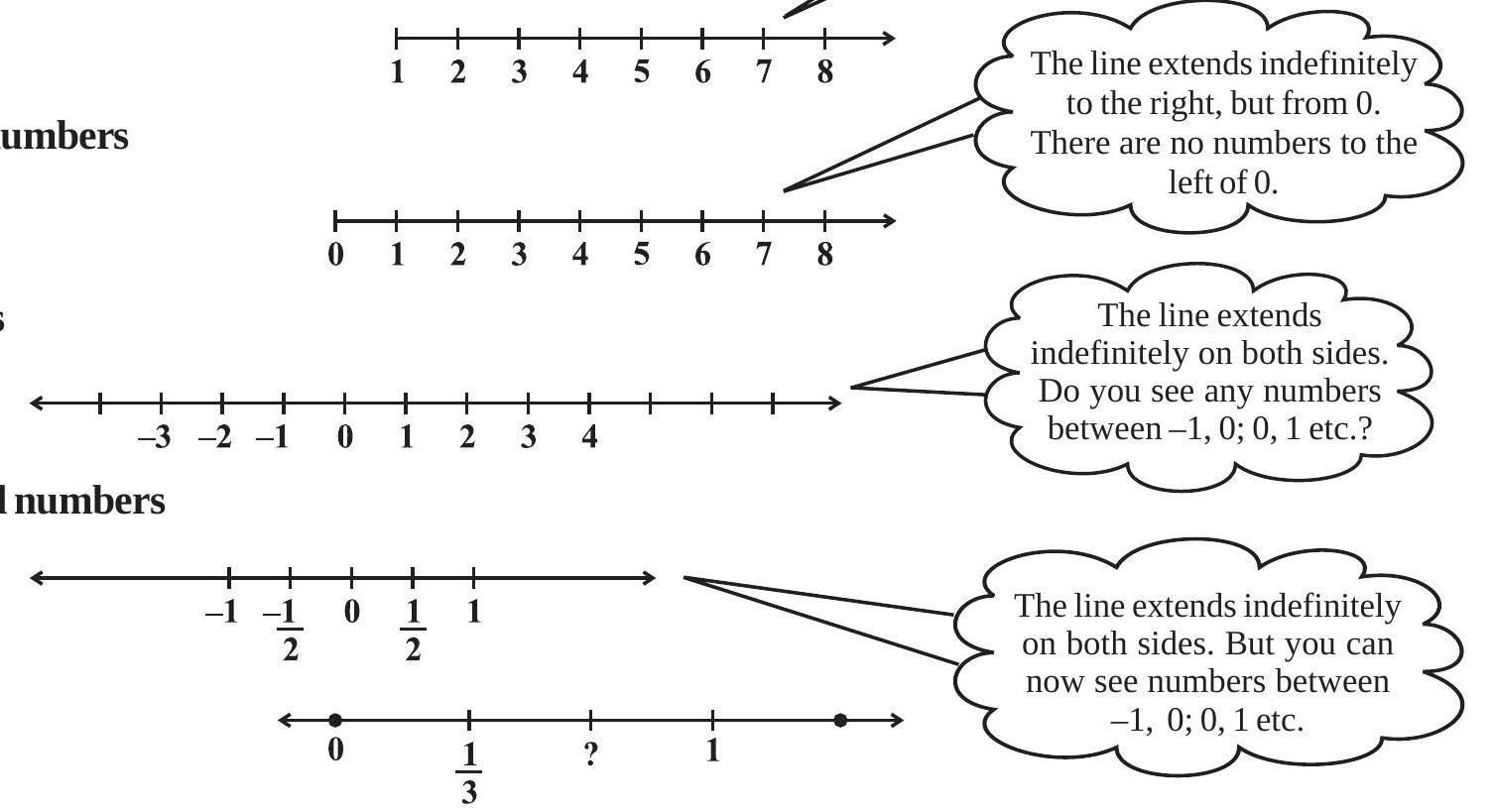
The point on the number line (iv) which is half way between 0 and 1 has been labelled \frac{1}{2}. Also, the first of the equally spaced points that divides the distance between 0 and 1 into three equal parts can be labelled \frac{1}{3}, as on number line (v). How would you label the second of these division points on number line (v)?
We find the mid point of AB which is C , represented by \left(\frac{1}{4}+\frac{1}{2}\right) \div 2=\frac{3}{8}.
We find that \frac{1}{4}<\frac{3}{8}<\frac{1}{2}.
If a and b are two rational numbers, then \frac{a+b}{2} is a rational number between a and b such that a<\frac{a+b}{2}<b.
This again shows that there are countless number of rational numbers between any two given rational numbers.
Example 9: Find three rational numbers between \frac{1}{4} and \frac{1}{2}.
Solution: We find the mean of the given rational numbers.
As given in the above example, the mean is \frac{3}{8} and \frac{1}{4}<\frac{3}{8}<\frac{1}{2}.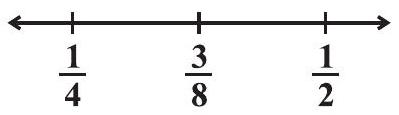
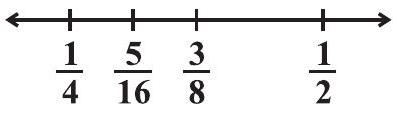
We now find another rational number between \frac{1}{4} and \frac{3}{8}. For this, we again find the mean of \frac{1}{4} and \frac{3}{8}. That is, \quad\left(\frac{1}{4}+\frac{3}{8}\right) \div 2=\frac{5}{8} \times \frac{1}{2}=\frac{5}{16}
\frac{1}{4}<\frac{5}{16}<\frac{3}{8}<\frac{1}{2}
Now find the mean of \frac{3}{8} and \frac{1}{2}. We have, \left(\frac{3}{8}+\frac{1}{2}\right) \div 2=\frac{7}{8} \times \frac{1}{2}=\frac{7}{16}
Thus we get \frac{1}{4}<\frac{5}{16}<\frac{3}{8}<\frac{7}{16}<\frac{1}{2}.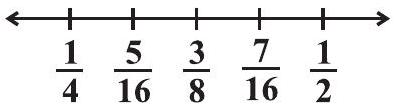
201
Thus, \frac{5}{16}, \frac{3}{8}, \frac{7}{16} are the three rational numbers between \frac{1}{4} and \frac{1}{2}.
This can clearly be shown on the number line as follows: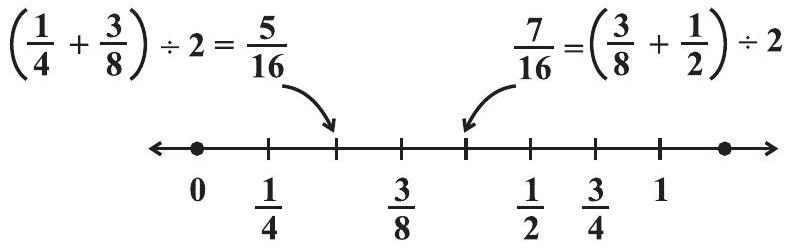
In the same way we can obtain as many rational numbers as we want between two given rational numbers. You have noticed that there are countless rational numbers between any two given rational numbers.
