
Class 11 NCERT Solutions
Chapter 2: Relations and Functions
Master the domain and range of real-valued functions, including Modulus, Signum, and Greatest Integer functions, with our step-by-step logic.
Exercise 2.1
1. If \(\left(\dfrac{x}{3}+1,\ y-\dfrac{2}{3}\right)=\left(\dfrac{5}{3},\ \dfrac{1}{3}\right)\), find the values of \(x\) and \(y\).
Solution:
Given: \(\left(\dfrac{x}{3}+1,\ y-\dfrac{2}{3}\right)=\left(\dfrac{5}{3},\ \dfrac{1}{3}\right)\)
Since the ordered pairs are equal, the corresponding elements are equal:
\(\dfrac{x}{3}+1=\dfrac{5}{3} \quad \text{and} \quad y-\dfrac{2}{3}=\dfrac{1}{3}\)
\(\Rightarrow \dfrac{x}{3}=\dfrac{5}{3}-1 \quad \text{and} \quad y=\dfrac{1}{3}+\dfrac{2}{3}\)
\(\Rightarrow x=2 \quad \text{and} \quad y=\dfrac{3}{3}=1\).
Given: \(\left(\dfrac{x}{3}+1,\ y-\dfrac{2}{3}\right)=\left(\dfrac{5}{3},\ \dfrac{1}{3}\right)\)
Since the ordered pairs are equal, the corresponding elements are equal:
\(\dfrac{x}{3}+1=\dfrac{5}{3} \quad \text{and} \quad y-\dfrac{2}{3}=\dfrac{1}{3}\)
\(\Rightarrow \dfrac{x}{3}=\dfrac{5}{3}-1 \quad \text{and} \quad y=\dfrac{1}{3}+\dfrac{2}{3}\)
\(\Rightarrow x=2 \quad \text{and} \quad y=\dfrac{3}{3}=1\).
2. If the set \(A\) has 3 elements and the set \(B=\{3,4,5\}\), then find the number of elements in \((\mathbf{A} \times \mathbf{B})\).
Solution:
Given: \(n(\mathrm{A})=3\) and \(\mathrm{B}=\{3,4,5\}\) so that \(n(\mathrm{B})=3\)
\(\therefore \quad n(\mathrm{A} \times \mathrm{B})=n(\mathrm{A}) \times n(\mathrm{B})=3 \times 3=9\).
Given: \(n(\mathrm{A})=3\) and \(\mathrm{B}=\{3,4,5\}\) so that \(n(\mathrm{B})=3\)
\(\therefore \quad n(\mathrm{A} \times \mathrm{B})=n(\mathrm{A}) \times n(\mathrm{B})=3 \times 3=9\).
3. If \(G=\{7,8\}\) and \(H=\{5,4,2\}\), find \(G \times H\) and \(H \times G\).
Solution:
Given \(\mathrm{G}=\{7,8\}\) and \(\mathrm{H}=\{5,4,2\}\)
\(\mathrm{G} \times \mathrm{H}=\{(x,y): x \in \mathrm{G} \text{ and } y \in \mathrm{H}\}\)
\(=\{(7,5),(7,4),(7,2),(8,5),(8,4),(8,2)\}\)
and \(\mathrm{H} \times \mathrm{G}=\{(x,y): x \in \mathrm{H} \text{ and } y \in \mathrm{G}\}\)
\(=\{(5,7),(5,8),(4,7),(4,8),(2,7),(2,8)\}\).
Given \(\mathrm{G}=\{7,8\}\) and \(\mathrm{H}=\{5,4,2\}\)
\(\mathrm{G} \times \mathrm{H}=\{(x,y): x \in \mathrm{G} \text{ and } y \in \mathrm{H}\}\)
\(=\{(7,5),(7,4),(7,2),(8,5),(8,4),(8,2)\}\)
and \(\mathrm{H} \times \mathrm{G}=\{(x,y): x \in \mathrm{H} \text{ and } y \in \mathrm{G}\}\)
\(=\{(5,7),(5,8),(4,7),(4,8),(2,7),(2,8)\}\).
4. State whether each of the following statements are true or false. If the statement is false, rewrite the given statement correctly.
(i) If \(\mathrm{P}=\{m,n\}\) and \(\mathbf{Q}=\{n,m\}\), then \(\mathrm{P} \times \mathrm{Q}=\{(m,n),(n,m)\}\).
(ii) If A and B are non-empty sets, then \(\mathrm{A} \times \mathrm{B}\) is a non-empty set of ordered pairs \((x,y)\) such that \(x \in \mathrm{A}\) and \(y \in \mathrm{B}\).
(iii) If \(\mathrm{A}=\{1,2\},\ \mathrm{B}=\{3,4\}\), then \(\mathrm{A} \times (\mathrm{B} \cap \phi)=\phi\).
(i) If \(\mathrm{P}=\{m,n\}\) and \(\mathbf{Q}=\{n,m\}\), then \(\mathrm{P} \times \mathrm{Q}=\{(m,n),(n,m)\}\).
(ii) If A and B are non-empty sets, then \(\mathrm{A} \times \mathrm{B}\) is a non-empty set of ordered pairs \((x,y)\) such that \(x \in \mathrm{A}\) and \(y \in \mathrm{B}\).
(iii) If \(\mathrm{A}=\{1,2\},\ \mathrm{B}=\{3,4\}\), then \(\mathrm{A} \times (\mathrm{B} \cap \phi)=\phi\).
Solution:
(i) False.
Since \(n(\mathrm{P})=2\) and \(n(\mathrm{Q})=2\), therefore \(n(\mathrm{P} \times \mathrm{Q})=n(\mathrm{P}) \times n(\mathrm{Q})=2 \times 2=4\).
Correct statement: \(\mathrm{P} \times \mathrm{Q}=\{(m,n),(m,m),(n,n),(n,m)\}\).
(ii) True.
(iii) \(\mathrm{A} \times (\mathrm{B} \cap \phi)=\mathrm{A} \times \phi=\phi\)
\(\therefore\) The given statement is true.
(i) False.
Since \(n(\mathrm{P})=2\) and \(n(\mathrm{Q})=2\), therefore \(n(\mathrm{P} \times \mathrm{Q})=n(\mathrm{P}) \times n(\mathrm{Q})=2 \times 2=4\).
Correct statement: \(\mathrm{P} \times \mathrm{Q}=\{(m,n),(m,m),(n,n),(n,m)\}\).
(ii) True.
(iii) \(\mathrm{A} \times (\mathrm{B} \cap \phi)=\mathrm{A} \times \phi=\phi\)
\(\therefore\) The given statement is true.
5. If \(A=\{-1,1\}\), find \(A \times A \times A\).
Solution:
Given: \(\mathrm{A}=\{-1,1\}\)
\(\mathrm{A} \times \mathrm{A}=\{-1,1\} \times \{-1,1\}=\{(-1,-1),(-1,1),(1,-1),(1,1)\}\)
\(\therefore \mathrm{A} \times \mathrm{A} \times \mathrm{A}=\{(-1,-1,-1),(-1,-1,1),(-1,1,-1),(-1,1,1),(1,-1,-1),(1,-1,1),(1,1,-1),(1,1,1)\}\)
Given: \(\mathrm{A}=\{-1,1\}\)
\(\mathrm{A} \times \mathrm{A}=\{-1,1\} \times \{-1,1\}=\{(-1,-1),(-1,1),(1,-1),(1,1)\}\)
\(\therefore \mathrm{A} \times \mathrm{A} \times \mathrm{A}=\{(-1,-1,-1),(-1,-1,1),(-1,1,-1),(-1,1,1),(1,-1,-1),(1,-1,1),(1,1,-1),(1,1,1)\}\)
6. If \(\mathrm{A} \times \mathrm{B}=\{(a,x),(a,y),(b,x),(b,y)\}\), find A and B.
Solution:
\(\mathrm{A}=\) set of first elements \(=\{a,b\}\) [Dropping repetitions]
\(\mathrm{B}=\) set of second elements \(=\{x,y\}\) [Dropping repetitions]
\(\mathrm{A}=\) set of first elements \(=\{a,b\}\) [Dropping repetitions]
\(\mathrm{B}=\) set of second elements \(=\{x,y\}\) [Dropping repetitions]
7. Let \(\mathrm{A}=\{1,2\},\ \mathrm{B}=\{1,2,3,4\},\ \mathrm{C}=\{5,6\}\) and \(\mathrm{D}=\{5,6,7,8\}\). Verify that
(i) \(\mathrm{A} \times (\mathrm{B} \cap \mathrm{C})=(\mathrm{A} \times \mathrm{B}) \cap (\mathrm{A} \times \mathrm{C})\).
(ii) \(\mathrm{A} \times \mathrm{C}\) is a subset of \(\mathrm{B} \times \mathrm{D}\).
(i) \(\mathrm{A} \times (\mathrm{B} \cap \mathrm{C})=(\mathrm{A} \times \mathrm{B}) \cap (\mathrm{A} \times \mathrm{C})\).
(ii) \(\mathrm{A} \times \mathrm{C}\) is a subset of \(\mathrm{B} \times \mathrm{D}\).
Solution:
(i) \(\mathrm{B} \cap \mathrm{C}=\{1,2,3,4\} \cap \{5,6\}=\phi\)
\(\therefore \mathrm{A} \times (\mathrm{B} \cap \mathrm{C})=\mathrm{A} \times \phi=\phi\) …(i)
Also, \(\mathrm{A} \times \mathrm{B}=\{1,2\} \times \{1,2,3,4\}=\{(1,1),(1,2),(1,3),(1,4),(2,1),(2,2),(2,3),(2,4)\}\)
and \(\mathrm{A} \times \mathrm{C}=\{1,2\} \times \{5,6\}=\{(1,5),(1,6),(2,5),(2,6)\}\)
\(\therefore (\mathrm{A} \times \mathrm{B}) \cap (\mathrm{A} \times \mathrm{C})=\{(1,1),(1,2),(1,3),(1,4),(2,1),(2,2),(2,3),(2,4)\} \cap \{(1,5),(1,6),(2,5),(2,6)\}=\phi\) …(ii)
From (i) and (ii), \(\mathrm{A} \times (\mathrm{B} \cap \mathrm{C})=(\mathrm{A} \times \mathrm{B}) \cap (\mathrm{A} \times \mathrm{C})\) is verified.
(ii) \(\mathrm{A} \times \mathrm{C}=\{1,2\} \times \{5,6\}=\{(1,5),(1,6),(2,5),(2,6)\}\)
\(\mathrm{B} \times \mathrm{D}=\{1,2,3,4\} \times \{5,6,7,8\}\)
\(=\{(1,5),(1,6),(1,7),(1,8),(2,5),(2,6),(2,7),(2,8),(3,5),(3,6),(3,7),(3,8),(4,5),(4,6),(4,7),(4,8)\}\)
Every element of \(\mathrm{A} \times \mathrm{C}\) is also an element of \(\mathrm{B} \times \mathrm{D}\).
\(\therefore \mathrm{A} \times \mathrm{C} \subset \mathrm{B} \times \mathrm{D}\) is verified.
(i) \(\mathrm{B} \cap \mathrm{C}=\{1,2,3,4\} \cap \{5,6\}=\phi\)
\(\therefore \mathrm{A} \times (\mathrm{B} \cap \mathrm{C})=\mathrm{A} \times \phi=\phi\) …(i)
Also, \(\mathrm{A} \times \mathrm{B}=\{1,2\} \times \{1,2,3,4\}=\{(1,1),(1,2),(1,3),(1,4),(2,1),(2,2),(2,3),(2,4)\}\)
and \(\mathrm{A} \times \mathrm{C}=\{1,2\} \times \{5,6\}=\{(1,5),(1,6),(2,5),(2,6)\}\)
\(\therefore (\mathrm{A} \times \mathrm{B}) \cap (\mathrm{A} \times \mathrm{C})=\{(1,1),(1,2),(1,3),(1,4),(2,1),(2,2),(2,3),(2,4)\} \cap \{(1,5),(1,6),(2,5),(2,6)\}=\phi\) …(ii)
From (i) and (ii), \(\mathrm{A} \times (\mathrm{B} \cap \mathrm{C})=(\mathrm{A} \times \mathrm{B}) \cap (\mathrm{A} \times \mathrm{C})\) is verified.
(ii) \(\mathrm{A} \times \mathrm{C}=\{1,2\} \times \{5,6\}=\{(1,5),(1,6),(2,5),(2,6)\}\)
\(\mathrm{B} \times \mathrm{D}=\{1,2,3,4\} \times \{5,6,7,8\}\)
\(=\{(1,5),(1,6),(1,7),(1,8),(2,5),(2,6),(2,7),(2,8),(3,5),(3,6),(3,7),(3,8),(4,5),(4,6),(4,7),(4,8)\}\)
Every element of \(\mathrm{A} \times \mathrm{C}\) is also an element of \(\mathrm{B} \times \mathrm{D}\).
\(\therefore \mathrm{A} \times \mathrm{C} \subset \mathrm{B} \times \mathrm{D}\) is verified.
8. Let \(\mathrm{A}=\{1,2\}\) and \(\mathrm{B}=\{3,4\}\). Write \(\mathrm{A} \times \mathrm{B}\). How many subsets will \(\mathrm{A} \times \mathrm{B}\) have? List them.
Solution:
\(\mathrm{A} \times \mathrm{B}=\{(a,b): a \in \mathrm{A},\ b \in \mathrm{B}\}=\{(1,3),(1,4),(2,3),(2,4)\}\)
Since \(n(\mathrm{A} \times \mathrm{B})=4\), \(\mathrm{A} \times \mathrm{B}\) will have \(2^4=16\) subsets.
Let \(a=(1,3),\ b=(1,4),\ c=(2,3),\ d=(2,4)\). The subsets are:
\(\phi,\ \{(1,3)\},\ \{(1,4)\},\ \{(2,3)\},\ \{(2,4)\},\)
\(\{(1,3),(1,4)\},\ \{(1,3),(2,3)\},\ \{(1,3),(2,4)\},\ \{(1,4),(2,3)\},\ \{(1,4),(2,4)\},\ \{(2,3),(2,4)\},\)
\(\{(1,3),(1,4),(2,3)\},\ \{(1,3),(1,4),(2,4)\},\ \{(1,3),(2,3),(2,4)\},\)
\(\{(1,4),(2,3),(2,4)\},\ \{(1,3),(1,4),(2,3),(2,4)\}\)
\(\mathrm{A} \times \mathrm{B}=\{(a,b): a \in \mathrm{A},\ b \in \mathrm{B}\}=\{(1,3),(1,4),(2,3),(2,4)\}\)
Since \(n(\mathrm{A} \times \mathrm{B})=4\), \(\mathrm{A} \times \mathrm{B}\) will have \(2^4=16\) subsets.
Let \(a=(1,3),\ b=(1,4),\ c=(2,3),\ d=(2,4)\). The subsets are:
\(\phi,\ \{(1,3)\},\ \{(1,4)\},\ \{(2,3)\},\ \{(2,4)\},\)
\(\{(1,3),(1,4)\},\ \{(1,3),(2,3)\},\ \{(1,3),(2,4)\},\ \{(1,4),(2,3)\},\ \{(1,4),(2,4)\},\ \{(2,3),(2,4)\},\)
\(\{(1,3),(1,4),(2,3)\},\ \{(1,3),(1,4),(2,4)\},\ \{(1,3),(2,3),(2,4)\},\)
\(\{(1,4),(2,3),(2,4)\},\ \{(1,3),(1,4),(2,3),(2,4)\}\)
9. Let \(A\) and \(B\) be two sets such that \(n(A)=3\) and \(n(B)=2\). If \((x,1),(y,2),(z,1)\) are in \(\mathrm{A} \times \mathrm{B}\), find \(\mathrm{A}\) and \(\mathrm{B}\), where \(x,y\) and \(z\) are distinct elements.
Solution:
Since \(n(\mathrm{A})=3\) and \(n(\mathrm{B})=2\), therefore \(n(\mathrm{A} \times \mathrm{B})=n(\mathrm{A}) \cdot n(\mathrm{B})=3 \times 2=6\).
Elements of A are the first elements and elements of B are the second elements in the ordered pairs of \(\mathrm{A} \times \mathrm{B}\).
Since \((x,1),(y,2),(z,1)\) are in \(\mathrm{A} \times \mathrm{B}\):
\(\therefore\) Set \(\mathrm{A}=\{x,y,z\}\) and set \(\mathrm{B}=\{1,2\}\).
Since \(n(\mathrm{A})=3\) and \(n(\mathrm{B})=2\), therefore \(n(\mathrm{A} \times \mathrm{B})=n(\mathrm{A}) \cdot n(\mathrm{B})=3 \times 2=6\).
Elements of A are the first elements and elements of B are the second elements in the ordered pairs of \(\mathrm{A} \times \mathrm{B}\).
Since \((x,1),(y,2),(z,1)\) are in \(\mathrm{A} \times \mathrm{B}\):
\(\therefore\) Set \(\mathrm{A}=\{x,y,z\}\) and set \(\mathrm{B}=\{1,2\}\).
10. The Cartesian product \(\mathrm{A} \times \mathrm{A}\) has 9 elements among which are found \((-1,0)\) and \((0,1)\). Find the set \(A\) and the remaining elements of \(\mathrm{A} \times \mathrm{A}\).
Solution:
Since \(n(\mathrm{A} \times \mathrm{A})=9=3 \times 3\), therefore \(n(\mathrm{A})=3\).
Since \((-1,0)\) and \((0,1)\) are in \(\mathrm{A} \times \mathrm{A}\), the elements at both places of ordered pairs are from A.
\(\therefore\) Set \(\mathrm{A}=\{-1,0,1\}\)
\(\mathrm{A} \times \mathrm{A}=\{-1,0,1\} \times \{-1,0,1\}\)
\(=\{(-1,-1),(-1,0),(-1,1),(0,-1),(0,0),(0,1),(1,-1),(1,0),(1,1)\}\)
The remaining elements of \(\mathrm{A} \times \mathrm{A}\) other than \((-1,0)\) and \((0,1)\) are:
\((-1,-1),(-1,1),(0,-1),(0,0),(1,-1),(1,0),(1,1)\).
Since \(n(\mathrm{A} \times \mathrm{A})=9=3 \times 3\), therefore \(n(\mathrm{A})=3\).
Since \((-1,0)\) and \((0,1)\) are in \(\mathrm{A} \times \mathrm{A}\), the elements at both places of ordered pairs are from A.
\(\therefore\) Set \(\mathrm{A}=\{-1,0,1\}\)
\(\mathrm{A} \times \mathrm{A}=\{-1,0,1\} \times \{-1,0,1\}\)
\(=\{(-1,-1),(-1,0),(-1,1),(0,-1),(0,0),(0,1),(1,-1),(1,0),(1,1)\}\)
The remaining elements of \(\mathrm{A} \times \mathrm{A}\) other than \((-1,0)\) and \((0,1)\) are:
\((-1,-1),(-1,1),(0,-1),(0,0),(1,-1),(1,0),(1,1)\).
Exercise 2.2
1. Let \(\mathrm{A}=\{1,2,3,\ldots,14\}\). Define a relation \(\mathrm{R}\) from A to A by \(\mathrm{R}=\{(x,y): 3x-y=0, \ \text{where} \ x,y \in \mathrm{A}\}\). Write down its domain, codomain and range.
Solution:
Here, \(\mathrm{A}=\{1,2,3,\ldots,14\}\) and
\(\mathrm{R}=\{(x,y): 3x-y=0, \ x,y \in \mathrm{A}\}=\{(x,y): y=3x, \ x=1,2,3,4\}\)
(when \(x \geq 5\), \(y=3x \geq 15\), so that \(y \notin \mathrm{A}\))
\(=\{(1,3),(2,6),(3,9),(4,12)\}\)
Domain of \(\mathrm{R}=\{1,2,3,4\}\)
Codomain of \(\mathrm{R}=\mathrm{A}=\{1,2,3,\ldots,14\}\)
Range of \(\mathrm{R}=\{3,6,9,12\}\).
Here, \(\mathrm{A}=\{1,2,3,\ldots,14\}\) and
\(\mathrm{R}=\{(x,y): 3x-y=0, \ x,y \in \mathrm{A}\}=\{(x,y): y=3x, \ x=1,2,3,4\}\)
(when \(x \geq 5\), \(y=3x \geq 15\), so that \(y \notin \mathrm{A}\))
\(=\{(1,3),(2,6),(3,9),(4,12)\}\)
Domain of \(\mathrm{R}=\{1,2,3,4\}\)
Codomain of \(\mathrm{R}=\mathrm{A}=\{1,2,3,\ldots,14\}\)
Range of \(\mathrm{R}=\{3,6,9,12\}\).
2. Define a relation \(R\) on the set \(N\) of natural numbers by \(\mathrm{R}=\{(x,y): y=x+5,\ x \ \text{is a natural number less than 4};\ x,y \in \mathrm{N}\}\). Depict this relationship using roster form. Write down the domain and the range.
Solution:
\(\mathrm{R}=\{(x,y): y=x+5,\ x \in \mathrm{N} \ \text{and} \ x < 4\}\)
\(=\{(x,y): y=x+5 \ \text{and} \ x=1,2,3\}\)
\(=\{(1,6),(2,7),(3,8)\}\)
Domain of \(\mathrm{R}=\{1,2,3\}\)
Range of \(\mathrm{R}=\{6,7,8\}\).
\(\mathrm{R}=\{(x,y): y=x+5,\ x \in \mathrm{N} \ \text{and} \ x < 4\}\)
\(=\{(x,y): y=x+5 \ \text{and} \ x=1,2,3\}\)
\(=\{(1,6),(2,7),(3,8)\}\)
Domain of \(\mathrm{R}=\{1,2,3\}\)
Range of \(\mathrm{R}=\{6,7,8\}\).
3. \(\mathbf{A}=\{1,2,3,5\}\) and \(\mathbf{B}=\{4,6,9\}\). Define a relation \(\mathrm{R}\) from \(\mathbf{A}\) to \(\mathbf{B}\) by \(\mathrm{R}=\{(x,y): \text{the difference between } x \text{ and } y \text{ is odd};\ x \in \mathrm{A},\ y \in \mathrm{B}\}\). Write \(\mathrm{R}\) in roster form.
Solution:
\(\mathrm{R}=\{(x,y): |x-y| \ \text{is odd};\ x \in \mathrm{A},\ y \in \mathrm{B}\}\)
\(=\{(1,4),(1,6),(2,9),(3,4),(3,6),(5,4),(5,6)\}\).
\(\mathrm{R}=\{(x,y): |x-y| \ \text{is odd};\ x \in \mathrm{A},\ y \in \mathrm{B}\}\)
\(=\{(1,4),(1,6),(2,9),(3,4),(3,6),(5,4),(5,6)\}\).
4. The figure shows a relationship between the sets P and Q.
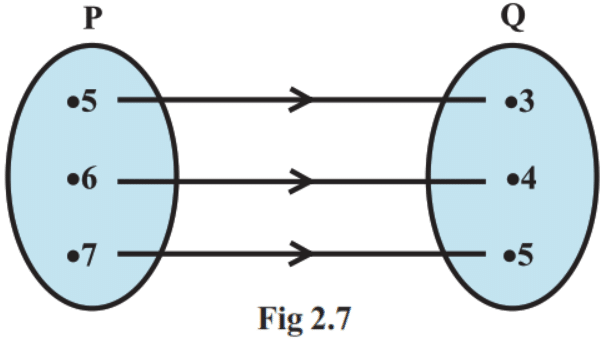
Write this relation (i) in set-builder form (ii) in roster form. What is its domain and range?
Write this relation (i) in set-builder form (ii) in roster form. What is its domain and range?
Solution:
From the figure, the ordered pairs \((5,3),(6,4)\) and \((7,5)\) belong to R. The second element of each ordered pair is two less than the first element.
(i) In set-builder form:
\(\mathrm{R}=\{(x,y): y=x-2, \ \text{where} \ x=5,6,7\}\)
(ii) In roster form:
\(\mathrm{R}=\{(5,3),(6,4),(7,5)\}\)
Domain of \(\mathrm{R}=\{5,6,7\}\)
Range of \(\mathrm{R}=\{3,4,5\}\)
From the figure, the ordered pairs \((5,3),(6,4)\) and \((7,5)\) belong to R. The second element of each ordered pair is two less than the first element.
(i) In set-builder form:
\(\mathrm{R}=\{(x,y): y=x-2, \ \text{where} \ x=5,6,7\}\)
(ii) In roster form:
\(\mathrm{R}=\{(5,3),(6,4),(7,5)\}\)
Domain of \(\mathrm{R}=\{5,6,7\}\)
Range of \(\mathrm{R}=\{3,4,5\}\)
5. Let \(A=\{1,2,3,4,6\}\). Let \(R\) be the relation on A defined by \(\{(a,b): a,b \in \mathrm{A},\ b \ \text{is exactly divisible by } a\}\).
(i) Write \(\mathrm{R}\) in roster form (ii) Find the domain of \(\mathrm{R}\) (iii) Find the range of \(\mathrm{R}\).
(i) Write \(\mathrm{R}\) in roster form (ii) Find the domain of \(\mathrm{R}\) (iii) Find the range of \(\mathrm{R}\).
Solution:
(i) \(\mathrm{R}=\{(a,b): a,b \in \mathrm{A},\ b \ \text{is exactly divisible by} \ a\}\)
\(=\{(1,1),(1,2),(1,3),(1,4),(1,6),(2,2),(2,4),(2,6),(3,3),(3,6),(4,4),(6,6)\}\)
(ii) Domain of \(\mathrm{R}=\{1,2,3,4,6\}=\mathrm{A}\)
(iii) Range of \(\mathrm{R}=\{1,2,3,4,6\}=\mathrm{A}\).
(i) \(\mathrm{R}=\{(a,b): a,b \in \mathrm{A},\ b \ \text{is exactly divisible by} \ a\}\)
\(=\{(1,1),(1,2),(1,3),(1,4),(1,6),(2,2),(2,4),(2,6),(3,3),(3,6),(4,4),(6,6)\}\)
(ii) Domain of \(\mathrm{R}=\{1,2,3,4,6\}=\mathrm{A}\)
(iii) Range of \(\mathrm{R}=\{1,2,3,4,6\}=\mathrm{A}\).
6. Determine the domain and range of the relation \(R\) defined by \(\mathrm{R}=\{(x,x+5): x \in \{0,1,2,3,4,5\}\}\).
Solution:
\(\mathrm{R}=\{(x,x+5): x \in \{0,1,2,3,4,5\}\}\)
\(=\{(0,5),(1,6),(2,7),(3,8),(4,9),(5,10)\}\)
Domain of \(\mathrm{R}=\{0,1,2,3,4,5\}\)
Range of \(\mathrm{R}=\{5,6,7,8,9,10\}\).
\(\mathrm{R}=\{(x,x+5): x \in \{0,1,2,3,4,5\}\}\)
\(=\{(0,5),(1,6),(2,7),(3,8),(4,9),(5,10)\}\)
Domain of \(\mathrm{R}=\{0,1,2,3,4,5\}\)
Range of \(\mathrm{R}=\{5,6,7,8,9,10\}\).
7. Write the relation \(\mathrm{R}=\{(x,x^3): x \ \text{is a prime number less than 10}\}\) in roster form.
Solution:
Prime numbers less than 10 are 2, 3, 5, 7.
\(\mathrm{R}=\{(x,x^3): x=2,3,5,7\}=\{(2,2^3),(3,3^3),(5,5^3),(7,7^3)\}=\{(2,8),(3,27),(5,125),(7,343)\}\).
Prime numbers less than 10 are 2, 3, 5, 7.
\(\mathrm{R}=\{(x,x^3): x=2,3,5,7\}=\{(2,2^3),(3,3^3),(5,5^3),(7,7^3)\}=\{(2,8),(3,27),(5,125),(7,343)\}\).
8. Let \(\mathrm{A}=\{x,y,z\}\) and \(\mathbf{B}=\{1,2\}\). Find the number of relations from A to B.
Solution:
\(n(\mathrm{A})=3\) and \(n(\mathrm{B})=2\), so \(n(\mathrm{A} \times \mathrm{B})=n(\mathrm{A}) \cdot n(\mathrm{B})=3 \cdot 2=6\).
Number of relations from \(\mathrm{A}\) to \(\mathrm{B}\) = Number of subsets of \(\mathrm{A} \times \mathrm{B}=2^6=64\).
\(n(\mathrm{A})=3\) and \(n(\mathrm{B})=2\), so \(n(\mathrm{A} \times \mathrm{B})=n(\mathrm{A}) \cdot n(\mathrm{B})=3 \cdot 2=6\).
Number of relations from \(\mathrm{A}\) to \(\mathrm{B}\) = Number of subsets of \(\mathrm{A} \times \mathrm{B}=2^6=64\).
9. Let \(\mathrm{R}\) be the relation on \(\mathrm{Z}\) defined by \(\mathrm{R}=\{(a,b): a,b \in \mathrm{Z},\ a-b \ \text{is an integer}\}\). Find the domain and range of \(\mathrm{R}\).
Solution:
Since \(a-b\) is an integer for all \(a,b \in \mathrm{Z}\),
\(\mathrm{R}=\{(a,b): a,b \in \mathrm{Z}\}\)
\(\Rightarrow\) Domain of \(\mathrm{R}=\mathrm{Z}\)
Range of \(\mathrm{R}=\mathrm{Z}\).
Since \(a-b\) is an integer for all \(a,b \in \mathrm{Z}\),
\(\mathrm{R}=\{(a,b): a,b \in \mathrm{Z}\}\)
\(\Rightarrow\) Domain of \(\mathrm{R}=\mathrm{Z}\)
Range of \(\mathrm{R}=\mathrm{Z}\).
Exercise 2.3
1. Which of the following relations are functions? Give reasons. If it is a function, determine its domain and range.
(i) \(\{(2,1),(5,1),(8,1),(11,1),(14,1),(17,1)\}\)
(ii) \(\{(2,1),(4,2),(6,3),(8,4),(10,5),(12,6),(14,7)\}\)
(iii) \(\{(1,3),(1,5),(2,5)\}\)
(i) \(\{(2,1),(5,1),(8,1),(11,1),(14,1),(17,1)\}\)
(ii) \(\{(2,1),(4,2),(6,3),(8,4),(10,5),(12,6),(14,7)\}\)
(iii) \(\{(1,3),(1,5),(2,5)\}\)
Solution:
(i) Domain \(=\{2,5,8,11,14,17\}\). Since every element of the domain has a unique image, this relation is a function.
Domain \(=\{2,5,8,11,14,17\}\), Range \(=\{1\}\).
(ii) Domain \(=\{2,4,6,8,10,12,14\}\). Since every element of the domain has a unique image, this relation is a function.
Domain \(=\{2,4,6,8,10,12,14\}\), Range \(=\{1,2,3,4,5,6,7\}\).
(iii) Domain \(=\{1,2\}\). Since the same first element 1 corresponds to two different images 3 and 5, this relation is not a function.
(i) Domain \(=\{2,5,8,11,14,17\}\). Since every element of the domain has a unique image, this relation is a function.
Domain \(=\{2,5,8,11,14,17\}\), Range \(=\{1\}\).
(ii) Domain \(=\{2,4,6,8,10,12,14\}\). Since every element of the domain has a unique image, this relation is a function.
Domain \(=\{2,4,6,8,10,12,14\}\), Range \(=\{1,2,3,4,5,6,7\}\).
(iii) Domain \(=\{1,2\}\). Since the same first element 1 corresponds to two different images 3 and 5, this relation is not a function.
2. Find the domain and range of the following real functions:
(i) \(f(x)=-|x|\) (ii) \(f(x)=\sqrt{9-x^2}\)
(i) \(f(x)=-|x|\) (ii) \(f(x)=\sqrt{9-x^2}\)
Solution:
(i) Since \(|x|\) is defined for all real numbers, \(-|x|\) is also defined for all real numbers.
\(\therefore\) Domain of \(f=\mathbf{R}\)
For all \(x \in \mathrm{R}\), \(|x| \geq 0 \Rightarrow -|x| \leq 0 \Rightarrow f(x) \leq 0\)
\(\therefore\) Range of \(f=(-\infty,0]\).
(ii) \(f(x)=\sqrt{9-x^2}\) is defined when \(9-x^2 \geq 0\).
\(\Rightarrow (3-x)(3+x) \geq 0 \Rightarrow x \in [-3,3]\)
\(\therefore\) Domain of \(f=[-3,3]\).
To find range: let \(y=\sqrt{9-x^2} \Rightarrow y^2=9-x^2 \Rightarrow x=\pm\sqrt{9-y^2}\).
\(x\) is real when \(9-y^2 \geq 0 \Rightarrow y \in [-3,3]\).
But \(y=\sqrt{9-x^2} \geq 0\).
\(\therefore\) Range of \(f=[0,3]\).
(i) Since \(|x|\) is defined for all real numbers, \(-|x|\) is also defined for all real numbers.
\(\therefore\) Domain of \(f=\mathbf{R}\)
For all \(x \in \mathrm{R}\), \(|x| \geq 0 \Rightarrow -|x| \leq 0 \Rightarrow f(x) \leq 0\)
\(\therefore\) Range of \(f=(-\infty,0]\).
(ii) \(f(x)=\sqrt{9-x^2}\) is defined when \(9-x^2 \geq 0\).
\(\Rightarrow (3-x)(3+x) \geq 0 \Rightarrow x \in [-3,3]\)
\(\therefore\) Domain of \(f=[-3,3]\).
To find range: let \(y=\sqrt{9-x^2} \Rightarrow y^2=9-x^2 \Rightarrow x=\pm\sqrt{9-y^2}\).
\(x\) is real when \(9-y^2 \geq 0 \Rightarrow y \in [-3,3]\).
But \(y=\sqrt{9-x^2} \geq 0\).
\(\therefore\) Range of \(f=[0,3]\).
3. A function \(f\) is defined by \(f(x)=2x-5\). Write down the values of
(i) \(f(0)\) (ii) \(f(7)\) (iii) \(f(-3)\)
(i) \(f(0)\) (ii) \(f(7)\) (iii) \(f(-3)\)
Solution:
Given: \(f(x)=2x-5\)
(i) \(f(0)=2 \times 0-5=-5\)
(ii) \(f(7)=2 \times 7-5=14-5=9\)
(iii) \(f(-3)=2 \times (-3)-5=-6-5=-11\)
Given: \(f(x)=2x-5\)
(i) \(f(0)=2 \times 0-5=-5\)
(ii) \(f(7)=2 \times 7-5=14-5=9\)
(iii) \(f(-3)=2 \times (-3)-5=-6-5=-11\)
4. The function ‘\(t\)’ which maps temperature in degree Celsius into temperature in degree Fahrenheit is defined by \(t(\mathrm{C})=\dfrac{9\mathrm{C}}{5}+32\). Find
(i) \(t(0)\) (ii) \(t(28)\) (iii) \(t(-10)\) (iv) The value of C when \(t(\mathrm{C})=212\).
(i) \(t(0)\) (ii) \(t(28)\) (iii) \(t(-10)\) (iv) The value of C when \(t(\mathrm{C})=212\).
Solution:
Given: \(t(\mathrm{C})=\dfrac{9\mathrm{C}}{5}+32\)
(i) \(t(0)=\dfrac{9 \times 0}{5}+32=0+32=32\)
(ii) \(t(28)=\dfrac{9 \times 28}{5}+32=\dfrac{252}{5}+32=50.4+32=82.4\)
(iii) \(t(-10)=\dfrac{9 \times (-10)}{5}+32=-18+32=14\)
(iv) \(t(\mathrm{C})=212 \Rightarrow \dfrac{9\mathrm{C}}{5}+32=212 \Rightarrow \dfrac{9\mathrm{C}}{5}=180 \Rightarrow \mathrm{C}=\dfrac{5}{9} \times 180=100\).
Given: \(t(\mathrm{C})=\dfrac{9\mathrm{C}}{5}+32\)
(i) \(t(0)=\dfrac{9 \times 0}{5}+32=0+32=32\)
(ii) \(t(28)=\dfrac{9 \times 28}{5}+32=\dfrac{252}{5}+32=50.4+32=82.4\)
(iii) \(t(-10)=\dfrac{9 \times (-10)}{5}+32=-18+32=14\)
(iv) \(t(\mathrm{C})=212 \Rightarrow \dfrac{9\mathrm{C}}{5}+32=212 \Rightarrow \dfrac{9\mathrm{C}}{5}=180 \Rightarrow \mathrm{C}=\dfrac{5}{9} \times 180=100\).
5. Find the range of each of the following functions:
(i) \(f(x)=2-3x,\ x \in \mathrm{R},\ x>0\)
(ii) \(f(x)=x^2+2\), \(x\) is a real number
(iii) \(f(x)=x\), \(x\) is a real number
(i) \(f(x)=2-3x,\ x \in \mathrm{R},\ x>0\)
(ii) \(f(x)=x^2+2\), \(x\) is a real number
(iii) \(f(x)=x\), \(x\) is a real number
Solution:
(i) Given \(x > 0\). Multiplying by \(-3\): \(-3x < 0\). Adding 2: \(2-3x < 2\), i.e., \(f(x) < 2\).
\(\Rightarrow\) Range of \(f=(-\infty,2)\).
(ii) \(x \in \mathbf{R} \Rightarrow x^2 \geq 0 \Rightarrow x^2+2 \geq 2 \Rightarrow f(x) \geq 2\).
\(\therefore\) Range of \(f=[2,\infty)\).
(iii) \(f(x)=x;\ x \in \mathrm{R} \Rightarrow f(x)\) takes all real values.
\(\therefore\) Range of \(f=\mathbf{R}\).
(i) Given \(x > 0\). Multiplying by \(-3\): \(-3x < 0\). Adding 2: \(2-3x < 2\), i.e., \(f(x) < 2\).
\(\Rightarrow\) Range of \(f=(-\infty,2)\).
(ii) \(x \in \mathbf{R} \Rightarrow x^2 \geq 0 \Rightarrow x^2+2 \geq 2 \Rightarrow f(x) \geq 2\).
\(\therefore\) Range of \(f=[2,\infty)\).
(iii) \(f(x)=x;\ x \in \mathrm{R} \Rightarrow f(x)\) takes all real values.
\(\therefore\) Range of \(f=\mathbf{R}\).
Miscellaneous Exercise
1. The relation \(f\) is defined by \(f(x)=\begin{cases} x^2, & 0 \leq x \leq 3 \\ 3x, & 3 \leq x \leq 10 \end{cases}\)
The relation \(g\) is defined by \(g(x)=\begin{cases} x^2, & 0 \leq x \leq 2 \\ 3x, & 2 \leq x \leq 10 \end{cases}\)
Show that \(f\) is a function and \(g\) is not a function.
The relation \(g\) is defined by \(g(x)=\begin{cases} x^2, & 0 \leq x \leq 2 \\ 3x, & 2 \leq x \leq 10 \end{cases}\)
Show that \(f\) is a function and \(g\) is not a function.
Solution:
The domain of \(f\) is \([0,10]\).
For each \(x \in [0,3)\), \(f(x)=x^2\) is uniquely defined.
For each \(x \in (3,10]\), \(f(x)=3x\) is uniquely defined.
At \(x=3\): \(x^2=9\) and \(3x=9\), so \(f\) is uniquely defined at 3.
Since every point of the domain has a unique image under \(f\), \(f\) is a function.
The domain of \(g\) is \([0,10]\).
At \(x=2\): \(g(x)=x^2=4\) and also \(g(x)=3x=6\).
Since the image of 2 is not unique (both \((2,4)\) and \((2,6)\) belong to \(g\)), \(g\) is not a function.
The domain of \(f\) is \([0,10]\).
For each \(x \in [0,3)\), \(f(x)=x^2\) is uniquely defined.
For each \(x \in (3,10]\), \(f(x)=3x\) is uniquely defined.
At \(x=3\): \(x^2=9\) and \(3x=9\), so \(f\) is uniquely defined at 3.
Since every point of the domain has a unique image under \(f\), \(f\) is a function.
The domain of \(g\) is \([0,10]\).
At \(x=2\): \(g(x)=x^2=4\) and also \(g(x)=3x=6\).
Since the image of 2 is not unique (both \((2,4)\) and \((2,6)\) belong to \(g\)), \(g\) is not a function.
2. If \(f(x)=x^2\), find \(\dfrac{f(1.1)-f(1)}{1.1-1}\).
Solution:
\(\dfrac{f(1.1)-f(1)}{1.1-1}=\dfrac{(1.1)^2-(1)^2}{1.1-1}=\dfrac{(1.1+1)(1.1-1)}{1.1-1}=1.1+1=2.1\)
\(\dfrac{f(1.1)-f(1)}{1.1-1}=\dfrac{(1.1)^2-(1)^2}{1.1-1}=\dfrac{(1.1+1)(1.1-1)}{1.1-1}=1.1+1=2.1\)
3. Find the domain of the function \(f(x)=\dfrac{x^2+2x+1}{x^2-8x+12}\).
Solution:
\(f\) is a rational function.
\(\therefore\) Domain of \(f=\mathrm{R}-\{x: x^2-8x+12=0\}\)
\(=\mathrm{R}-\{x:(x-2)(x-6)=0\}\)
\(=\mathrm{R}-\{2,6\}\).
\(f\) is a rational function.
\(\therefore\) Domain of \(f=\mathrm{R}-\{x: x^2-8x+12=0\}\)
\(=\mathrm{R}-\{x:(x-2)(x-6)=0\}\)
\(=\mathrm{R}-\{2,6\}\).
4. Find the domain and the range of the real function \(f\) defined by \(f(x)=\sqrt{x-1}\).
Solution:
\(f\) is real only when \(x-1 \geq 0\), i.e., \(x \geq 1\).
\(\therefore\) Domain of \(f=[1,\infty)\)
Let \(y=f(x)=\sqrt{x-1}\). Clearly \(y \geq 0\).
Also, \(y^2=x-1 \Rightarrow x=1+y^2\), which is real for all \(y \in \mathrm{R}\).
\(\therefore\) Range of \(f=\{y: y \geq 0,\ y \in \mathrm{R}\}=[0,\infty)\).
\(f\) is real only when \(x-1 \geq 0\), i.e., \(x \geq 1\).
\(\therefore\) Domain of \(f=[1,\infty)\)
Let \(y=f(x)=\sqrt{x-1}\). Clearly \(y \geq 0\).
Also, \(y^2=x-1 \Rightarrow x=1+y^2\), which is real for all \(y \in \mathrm{R}\).
\(\therefore\) Range of \(f=\{y: y \geq 0,\ y \in \mathrm{R}\}=[0,\infty)\).
5. Find the domain and the range of the real function \(f\) defined by \(f(x)=|x-1|\).
Solution:
For all \(x \in \mathrm{R}\), \(f(x)\) is a unique real number.
\(\therefore\) Domain of \(f=\mathbf{R}\).
For all \(x \in \mathrm{R}\), \(|x-1| \geq 0 \Rightarrow f(x) \geq 0\).
\(\therefore\) Range of \(f=[0,\infty)\).
For all \(x \in \mathrm{R}\), \(f(x)\) is a unique real number.
\(\therefore\) Domain of \(f=\mathbf{R}\).
For all \(x \in \mathrm{R}\), \(|x-1| \geq 0 \Rightarrow f(x) \geq 0\).
\(\therefore\) Range of \(f=[0,\infty)\).
6. Let \(f=\left\{\left(x,\dfrac{x^2}{1+x^2}\right): x \in \mathrm{R}\right\}\) be a function from \(\mathbf{R}\) into R. Determine the range of \(f\).
Solution:
\(y=f(x)=\dfrac{x^2}{1+x^2}\)
Since \(x^2 \geq 0\), we have \(y \geq 0\) for all \(x \in \mathrm{R}\) …(ii)
Also, \(y=\dfrac{x^2}{1+x^2}=1-\dfrac{1}{1+x^2} < 1\) for all \(x \in \mathrm{R}\) ...(iii)
From (ii) and (iii): \(0 \leq y < 1\).
\(\therefore\) Range of \(f=[0,1)\).
\(y=f(x)=\dfrac{x^2}{1+x^2}\)
Since \(x^2 \geq 0\), we have \(y \geq 0\) for all \(x \in \mathrm{R}\) …(ii)
Also, \(y=\dfrac{x^2}{1+x^2}=1-\dfrac{1}{1+x^2} < 1\) for all \(x \in \mathrm{R}\) ...(iii)
From (ii) and (iii): \(0 \leq y < 1\).
\(\therefore\) Range of \(f=[0,1)\).
7. Let \(f,g: \mathrm{R} \rightarrow \mathrm{R}\) be defined respectively by \(f(x)=x+1,\ g(x)=2x-3\). Find \(f+g,\ f-g\) and \(\dfrac{f}{g}\).
Solution:
\((f+g)(x)=f(x)+g(x)=(x+1)+(2x-3)=3x-2\)
\((f-g)(x)=f(x)-g(x)=(x+1)-(2x-3)=-x+4\)
\(\left(\dfrac{f}{g}\right)(x)=\dfrac{f(x)}{g(x)}=\dfrac{x+1}{2x-3}, \quad x \neq \dfrac{3}{2}\)
\((f+g)(x)=f(x)+g(x)=(x+1)+(2x-3)=3x-2\)
\((f-g)(x)=f(x)-g(x)=(x+1)-(2x-3)=-x+4\)
\(\left(\dfrac{f}{g}\right)(x)=\dfrac{f(x)}{g(x)}=\dfrac{x+1}{2x-3}, \quad x \neq \dfrac{3}{2}\)
8. Let \(f=\{(1,1),(2,3),(0,-1),(-1,-3)\}\) be a function from \(\mathrm{Z}\) to \(\mathrm{Z}\) defined by \(f(x)=ax+b\) for some integers \(a,b\). Determine \(a,b\).
Solution:
Given \(f(x)=ax+b\).
\((1,1) \in f \Rightarrow f(1)=1 \Rightarrow a+b=1\) …(ii)
\((2,3) \in f \Rightarrow f(2)=3 \Rightarrow 2a+b=3\) …(iii)
Subtracting (ii) from (iii): \(a=2\).
Putting in (ii): \(1=2+b \Rightarrow b=-1\).
\(\therefore a=2,\ b=-1\).
Given \(f(x)=ax+b\).
\((1,1) \in f \Rightarrow f(1)=1 \Rightarrow a+b=1\) …(ii)
\((2,3) \in f \Rightarrow f(2)=3 \Rightarrow 2a+b=3\) …(iii)
Subtracting (ii) from (iii): \(a=2\).
Putting in (ii): \(1=2+b \Rightarrow b=-1\).
\(\therefore a=2,\ b=-1\).
9. Let \(R\) be a relation from \(N\) to \(N\) defined by \(\mathrm{R}=\{(a,b): a,b \in \mathrm{N} \ \text{and} \ a=b^2\}\). Are the following true?
(i) \((a,a) \in \mathrm{R}\), for all \(a \in \mathrm{N}\)
(ii) \((a,b) \in \mathrm{R}\) implies \((b,a) \in \mathrm{R}\)
(iii) \((a,b) \in \mathrm{R},\ (b,c) \in \mathrm{R}\) implies \((a,c) \in \mathrm{R}\)
(i) \((a,a) \in \mathrm{R}\), for all \(a \in \mathrm{N}\)
(ii) \((a,b) \in \mathrm{R}\) implies \((b,a) \in \mathrm{R}\)
(iii) \((a,b) \in \mathrm{R},\ (b,c) \in \mathrm{R}\) implies \((a,c) \in \mathrm{R}\)
Solution:
(i) Except for \(a=1\), no natural number equals its own square.
\(\therefore (a,a) \in \mathrm{R}\) is false in general (it does not satisfy \(a=b^2\) for \(a \neq 1\)).
(ii) If \(a=b^2\), it does not imply \(b=a^2\). For example, \((4,2) \in \mathrm{R}\) (\(\because 4=2^2\)) but \((2,4) \notin \mathrm{R}\) (\(\because 2 \neq 4^2\)).
\(\therefore\) The statement is false.
(iii) \((a,b) \in \mathrm{R} \Rightarrow a=b^2\) and \((b,c) \in \mathrm{R} \Rightarrow b=c^2\).
Substituting: \(a=c^4 \neq c^2\) in general, so \((a,c) \notin \mathrm{R}\).
For example, \((16,4) \in \mathrm{R}\) and \((4,2) \in \mathrm{R}\) but \((16,2) \notin \mathrm{R}\) (\(\because 16 \neq 2^2\)).
\(\therefore\) The statement is false.
(i) Except for \(a=1\), no natural number equals its own square.
\(\therefore (a,a) \in \mathrm{R}\) is false in general (it does not satisfy \(a=b^2\) for \(a \neq 1\)).
(ii) If \(a=b^2\), it does not imply \(b=a^2\). For example, \((4,2) \in \mathrm{R}\) (\(\because 4=2^2\)) but \((2,4) \notin \mathrm{R}\) (\(\because 2 \neq 4^2\)).
\(\therefore\) The statement is false.
(iii) \((a,b) \in \mathrm{R} \Rightarrow a=b^2\) and \((b,c) \in \mathrm{R} \Rightarrow b=c^2\).
Substituting: \(a=c^4 \neq c^2\) in general, so \((a,c) \notin \mathrm{R}\).
For example, \((16,4) \in \mathrm{R}\) and \((4,2) \in \mathrm{R}\) but \((16,2) \notin \mathrm{R}\) (\(\because 16 \neq 2^2\)).
\(\therefore\) The statement is false.
10. Let \(\mathrm{A}=\{1,2,3,4\},\ \mathrm{B}=\{1,5,9,11,15,16\}\) and \(f=\{(1,5),(2,9),(3,1),(4,5),(2,11)\}\). Are the following true?
(i) \(f\) is a relation from A to B (ii) \(f\) is a function from A to B
Justify your answer in each case.
(i) \(f\) is a relation from A to B (ii) \(f\) is a function from A to B
Justify your answer in each case.
Solution:
(i) Every element of \(f\) is an element of \(\mathrm{A} \times \mathrm{B} \Rightarrow f \subset \mathrm{A} \times \mathrm{B}\).
Since every subset of \(\mathrm{A} \times \mathrm{B}\) is a relation from A to B, \(f\) is a relation from A to B. True.
(ii) Both \((2,9)\) and \((2,11)\) belong to \(f\), meaning the \(f\)-image of 2 is not unique.
\(\therefore f\) is not a function from A to B. False.
(i) Every element of \(f\) is an element of \(\mathrm{A} \times \mathrm{B} \Rightarrow f \subset \mathrm{A} \times \mathrm{B}\).
Since every subset of \(\mathrm{A} \times \mathrm{B}\) is a relation from A to B, \(f\) is a relation from A to B. True.
(ii) Both \((2,9)\) and \((2,11)\) belong to \(f\), meaning the \(f\)-image of 2 is not unique.
\(\therefore f\) is not a function from A to B. False.
11. Let \(f\) be the subset of \(\mathrm{Z} \times \mathrm{Z}\) defined by \(f=\{(ab,\ a+b): a,b \in \mathrm{Z}\}\). Is \(f\) a function from Z to Z? Justify your answer.
Solution:
Taking \(a=b=1\): \((ab,a+b)=(1,2) \in f\).
Taking \(a=b=-1\): \((ab,a+b)=(1,-2) \in f\).
\(\Rightarrow\) The \(f\)-image of 1 is not unique.
\(\therefore f\) is not a function.
Taking \(a=b=1\): \((ab,a+b)=(1,2) \in f\).
Taking \(a=b=-1\): \((ab,a+b)=(1,-2) \in f\).
\(\Rightarrow\) The \(f\)-image of 1 is not unique.
\(\therefore f\) is not a function.
12. Let \(\mathbf{A}=\{9,10,11,12,13\}\) and let \(f: \mathrm{A} \rightarrow \mathrm{N}\) be defined by \(f(n)=\) the highest prime factor of \(n\). Find the range of \(f\).
Solution:
\(f(9)=3\) (only prime factor of 9 is 3)
\(f(10)=5\) (prime factors of 10 are 2 and 5)
\(f(11)=11\) (11 is prime)
\(f(12)=3\) (prime factors of 12 are 2 and 3)
\(f(13)=13\) (13 is prime)
Range of \(f=\{f(9),f(10),f(11),f(12),f(13)\}=\{3,5,11,3,13\}=\{3,5,11,13\}\). [Dropping repetitions]
\(f(9)=3\) (only prime factor of 9 is 3)
\(f(10)=5\) (prime factors of 10 are 2 and 5)
\(f(11)=11\) (11 is prime)
\(f(12)=3\) (prime factors of 12 are 2 and 3)
\(f(13)=13\) (13 is prime)
Range of \(f=\{f(9),f(10),f(11),f(12),f(13)\}=\{3,5,11,3,13\}=\{3,5,11,13\}\). [Dropping repetitions]
Test Your Mathematical Logic
Complete the Chapter 1 quiz to unlock your performance badge.
| Pos. | Name | Score | Duration |
|---|---|---|---|
| There is no data yet |
Download Assignments, DPP’s here
Get the editable Word files and premium DPPs for this chapter.