

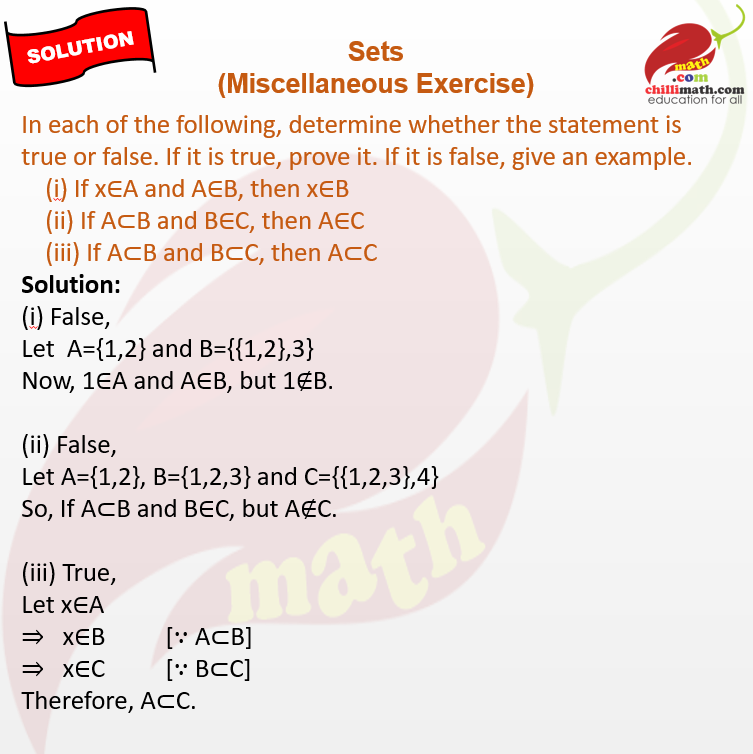
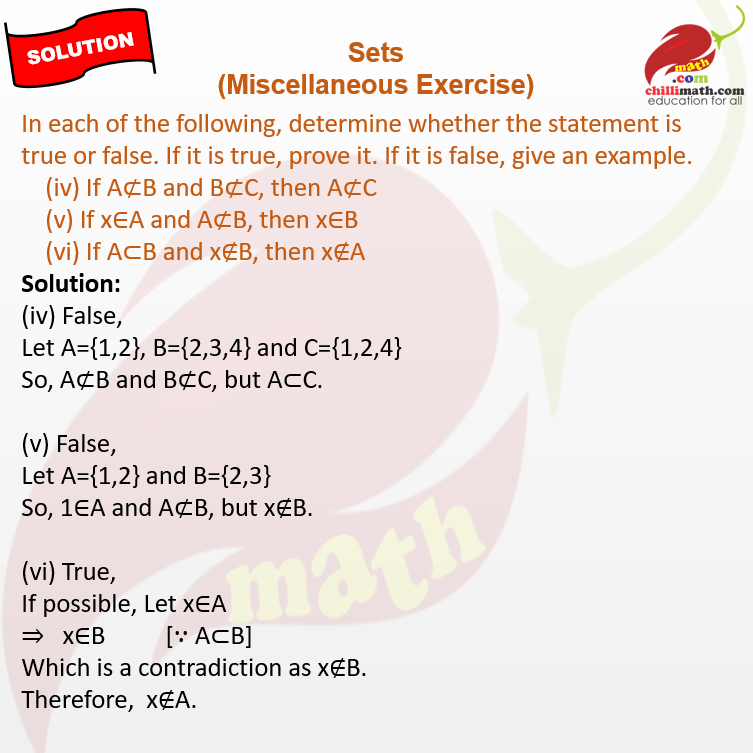
2. In each of the following, determine whether the statement is true or false. If it is true, prove it. If it is false, give an example.
(i) If x∈A and A∈B, then x∈B
(ii) If A⊂B and B∈C, then A∈C
(iii) If A⊂B and B⊂C, then A⊂C
(iv) If A⊄B and B⊄C, then A⊄C
(v) If x∈A and A⊄B, then x∈B
(vi) If A⊂B and x∉B, then x∉A
Sets
Miscellaneous Exercise
Class 11
Sets
Miscellaneous Exercise
1. Decide, among the following sets, which sets are subsets of one and another:
A={x : x∈R and x satisfy x2–8x+12=0}, B={2,4,6}, C={2,4,6,8, . . . }, D={6}.
(iii) If A⊂B and B⊂C, then A⊂C
3. Let A, B, and C be the sets such that A∪B=A∪C and A∩B=A∩C. Show that B=C.
4. Show that the following four conditions are equivalent:
5. Show that if AB, then C–B ⊂ C–A.
6. Show that for any sets A and B,
A=(A∩B)∪(A–B) and A∪(B–A)=(A∪B).
7. Using properties of sets, show that
8. Show that A∩B=A∩C need not imply B=C.
9. Let A and B be sets. If A∩X=B∩X=(phi) and A∪X=B∪X for some set X, show that A=B.
(Hints A=A∩(A∪X), B=B∩(B∪X) and use Distributive law)
10. Find sets A, B and C such that A∩B, B∩C and A∩C are non-empty sets and A∩B∩C=(phi).
