
Class 10 NCERT Solutions
Chapter 2: Polynomials
Master the geometrical meaning of zeroes, the relationship between coefficients and roots, and the algebraic division of polynomials with our step-by-step logic.
Exercise 2.1
1. The graphs of y = p(x) are given in the following figure, for some polynomials p(x). Find the number of zeroes of p(x), in each case.
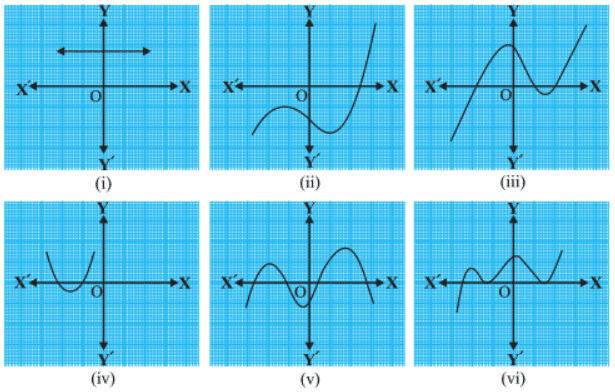
The key rule to remember: the number of zeroes of a polynomial equals the number of times its graph crosses or touches the $x$-axis.
(i) As the graph of polynomial does not meet $x$-axis at all, the polynomial has no zeroes.
(ii) As the graph of polynomial cuts (meets) $x$-axis only once, the polynomial has exactly one zero.
(iii) As the graph of polynomial cuts (meets) $x$-axis thrice, the polynomial has three zeroes.
(iv) As the graph of polynomial cuts (meets) $x$-axis twice, the polynomial has exactly two zeroes.
(v) As the graph of polynomial cuts (meets) $x$-axis four times, the polynomial has four zeroes.
(vi) As the graph of polynomial cuts (meets) $x$-axis three times, the polynomial has three zeroes.
Exercise 2.2
1. Find the zeroes of the following quadratic polynomials and verify the relationship between the zeroes and the coefficients.
(i) $x^2-2x-8$
(ii) $4s^2-4s+1$
(iii) $6x^2-3-7x$
(iv) $4u^2+8u$
(v) $t^2-15$
(vi) $3x^2-x-4$
(ii) $4s^2-4s+1$
(iii) $6x^2-3-7x$
(iv) $4u^2+8u$
(v) $t^2-15$
(vi) $3x^2-x-4$
(i) Consider polynomial $x^2-2x-8=(x-4)(x+2)$
We factorise the polynomial and set each factor equal to zero to find the zeroes.
For zeroes, $x-4=0,\ x+2=0$
$$\Rightarrow x=4,\ -2$$Zeroes of the polynomial are 4 and $-2$.
Now we check both Vieta’s relationships — the sum and product of zeroes must match the ratios of the coefficients.
$$\begin{aligned} \text{Sum of zeroes} &= 4+(-2)=2 \\ &= \frac{-(-2)}{1}=\frac{-\text{ Coefficient of }x}{\text{Coefficient of }x^2} \end{aligned}$$Product of zeroes $=4\times(-2)=-8$
$$=\frac{-8}{1}=\frac{\text{Constant term}}{\text{Coefficient of }x^2}$$Hence verified.
(ii) Consider polynomial $4s^2-4s+1=(2s-1)^2$
Notice that this polynomial is a perfect square, which means it will have a repeated zero.
For zeroes, $4s^2-4s+1=0$
$$\begin{array}{ll} \therefore & (2s-1)^2=0 \\ \Rightarrow & 2s-1=0 \Rightarrow s=\dfrac{1}{2} \end{array}$$∴ Polynomial has equal zeroes, i.e., $\dfrac{1}{2}$ and $\dfrac{1}{2}$.
$$\begin{aligned} \text{Sum of zeroes} &= \frac{1}{2}+\frac{1}{2}=1=\frac{4}{4} \\ &= -\frac{(-4)}{4}=-\frac{\text{Coefficient of }s}{\text{Coefficient of }s^2} \end{aligned}$$Product of zeroes $=\dfrac{1}{2}\cdot\dfrac{1}{2}=\dfrac{1}{4}=\dfrac{\text{Constant term}}{\text{Coefficient of }s^2}$
Hence verified.
(iii) Consider polynomial $6x^2-3-7x=6x^2-7x-3$
We first rearrange in standard form, then factorise by splitting the middle term.
$$\begin{aligned} &= 6x^2-9x+2x-3 \\ &= 3x(2x-3)+1(2x-3) \\ &= (2x-3)(3x+1) \end{aligned}$$For zeroes, $2x-3=0,\ 3x+1=0$
$$\Rightarrow x=\frac{3}{2},\ -\frac{1}{3}$$⇒ Zeroes of polynomial are $\dfrac{3}{2}$ and $-\dfrac{1}{3}$.
Sum of zeroes $=\dfrac{3}{2}-\dfrac{1}{3}=\dfrac{7}{6}=\dfrac{-(-7)}{6}$
$$=-\frac{\text{Coefficient of }x}{\text{Coefficient of }x^2}$$Product of zeroes $=\dfrac{3}{2}\times\dfrac{(-1)}{3}$
$$=\frac{-1}{2}=\frac{-3}{6}=\frac{\text{Constant term}}{\text{Coefficient of }x^2}$$Hence verified.
(iv) Consider polynomial $4u^2+8u=4u(u+2)$
We factorise by taking out the common factor $4u$, which directly reveals both zeroes.
For zeroes, $4u(u+2)=0$
$$\Rightarrow u=0 \text{ or } u+2=0$$∴ Zeroes of the polynomial are 0 and $-2$.
$$\begin{aligned} \text{Sum of zeroes} &= 0+(-2) \\ &= -2=\frac{-8}{4} \\ &= \frac{-\text{Coefficient of }u}{\text{Coefficient of }u^2} \end{aligned}$$Product of zeroes $=0\times(-2)=0=\dfrac{0}{4}$
$$=\frac{\text{Constant term}}{\text{Coefficient of }u^2}$$Hence verified.
(v) Consider polynomial $t^2-15=(t-\sqrt{15})(t+\sqrt{15})$
This is a difference-of-squares form, which factors neatly into two conjugate expressions.
For zeroes, $(t-\sqrt{15})(t+\sqrt{15})=0$
$$\begin{aligned} &\Rightarrow t-\sqrt{15}=0,\ t+\sqrt{15}=0 \\ &\Rightarrow t=\sqrt{15},\ t=-\sqrt{15} \end{aligned}$$∴ Zeroes of the polynomial are $\sqrt{15}$ and $-\sqrt{15}$.
$$\begin{aligned} \text{Sum of zeroes} &= \sqrt{15}+(-\sqrt{15})=0 \\ &= -\frac{0}{1}=-\frac{\text{Coefficient of }t}{\text{Coefficient of }t^2} \end{aligned}$$Product of zeroes $=(\sqrt{15})(-\sqrt{15})=-15=\dfrac{-15}{1}$
$$=\frac{\text{Constant term}}{\text{Coefficient of }t^2}$$Hence verified.
(vi) Consider polynomial $3x^2-x-4=3x^2-4x+3x-4$
We split the middle term so that the sum is $-1$ and the product is $3\times(-4)=-12$, giving $-4$ and $+3$.
$$\begin{aligned} &= x(3x-4)+1(3x-4) \\ &= (x+1)(3x-4) \end{aligned}$$For zeroes, $(x+1)(3x-4)=0$
$$\begin{aligned} \Rightarrow && x+1=0,\ 3x-4 &= 0 \\ \Rightarrow && x &= -1,\ \frac{4}{3} \end{aligned}$$∴ Zeroes of the polynomial are $-1$ and $\dfrac{4}{3}$.
Sum of zeroes $=-1+\dfrac{4}{3}=\dfrac{1}{3}=-\dfrac{(-1)}{3}$
$$=-\frac{\text{Coefficient of }x}{\text{Coefficient of }x^2}$$Product of zeroes $=(-1)\left(\dfrac{4}{3}\right)=\dfrac{-4}{3}$
$$=\frac{\text{Constant term}}{\text{Coefficient of }x^2}$$Hence verified.
2. Find a quadratic polynomial each with the given numbers as the sum and product of its zeroes respectively.
(i) $\dfrac{1}{4},\ -1$
(ii) $\sqrt{2},\ \dfrac{1}{3}$
(iii) $0,\ \sqrt{5}$
(iv) $1,\ 1$
(v) $-\dfrac{1}{4},\ \dfrac{1}{4}$
(vi) $4,\ 1$
The general approach for every part: assume $f(x)=ax^2+bx+c$, then use the given sum and product to read off the values of $a$, $b$, and $c$ from the coefficient relationships.
(i) Let polynomial be $f(x)=ax^2+bx+c$
Sum of zeroes
$$\begin{aligned} &= \frac{1}{4}=-\frac{(-1)}{4}=-\frac{b}{a} \end{aligned}$$Product of zeroes
$$-1=\frac{-4}{4}=\frac{c}{a}$$From equations (ii) and (iii), we get
$$a=4,\ b=-1,\ c=-4$$Substituting these values in equation (i), we get
Polynomial $f(x)=4x^2-x-4$.
We can have infinite such polynomials as $f(x)=k(4x^2-x-4)$, $k$ is a real number.
(ii) Let polynomial be $f(x)=ax^2+bx+c$
Sum of zeroes
$$\begin{aligned} &= \sqrt{2}=-\frac{(-3\sqrt{2})}{3} \\ &= -\frac{b}{a} \end{aligned}$$Product of zeroes $=\dfrac{1}{3}=\dfrac{c}{a}$
From equations (ii) and (iii), we get
$$a=3,\ b=-3\sqrt{2},\ c=1$$Substituting these values in equation (i), we get
Polynomial $f(x)=3x^2-3\sqrt{2}\,x+1$.
or $f(x)=k(3x^2-3\sqrt{2}\,x+1)$, $k$ is a real number.
(iii) Let polynomial be $f(x)=ax^2+bx+c$
Sum of zeroes
$$=0=-\frac{(-0)}{1}=-\frac{b}{a}$$Product of zeroes
$$=\sqrt{5}=\frac{\sqrt{5}}{1}=\frac{c}{a}$$From equations (ii) and (iii), we get
$$a=1,\ b=0,\ c=\sqrt{5}$$Substituting these values in equation (i), we get
Polynomial $f(x)=x^2+\sqrt{5}$.
or $f(x)=k(x^2+\sqrt{5})$, $k$ is a real number.
(iv) Let polynomial be $f(x)=ax^2+bx+c$
Sum of zeroes
$$\begin{aligned} &= 1=\frac{1}{1}=-\frac{(-1)}{1} \\ &= -\frac{b}{a} \end{aligned}$$Product of zeroes $=1=\dfrac{1}{1}=\dfrac{c}{a}$
From equations (ii) and (iii), we get
$$a=1,\ b=-1,\ c=1$$Substituting these values in equation (i), we get
Polynomial $f(x)=x^2-x+1$.
or $f(x)=k(x^2-x+1)$, $k$ is a real number.
(v) Let polynomial be $f(x)=ax^2+bx+c$
Sum of zeroes
$$=-\frac{1}{4}=-\frac{1}{4}=-\frac{b}{a}$$Product of zeroes $=\dfrac{1}{4}=\dfrac{c}{a}$
From equations (ii) and (iii), we get
$$a=4,\ b=1,\ c=1$$Substituting these values in equation (i), we get
Polynomial $f(x)=4x^2+x+1$.
or $f(x)=k(4x^2+x+1)$, $k$ is a real number.
(vi) Let polynomial be $f(x)=ax^2+bx+c$
Sum of zeroes
$$=4=-\frac{(-4)}{1}=-\frac{b}{a}$$Product of zeroes
$$=1=\frac{1}{1}=\frac{c}{a}$$From equations (ii) and (iii), we get
$$a=1,\ b=-4,\ c=1$$Substituting these values in equation (i), we get
Polynomial $f(x)=x^2-4x+1$.
or $f(x)=k(x^2-4x+1)$, $k$ is a real number.
Test Your Mathematical Logic
Complete the Chapter 1 quiz to unlock your performance badge.
| Pos. | Name | Score | Duration |
|---|---|---|---|
| There is no data yet |
Download Assignments, DPP’s here
Get the editable Word files and premium DPPs for this chapter.